CSE 311: Section 0
Task 1 – Warm Up
Translate these English statements into propositional logic, making the atomic propositions as simple as possible and exposing as much of the logic via symbols as possible.
“If I am lifting weights this afternoon, then I do a warm-up exercise.”
“I can go home only if I have finished my homework.”
Task 2 – More Translations
Translate these English statements into propositional logic, making the atomic propositions as simple as possible and exposing as much of the logic via symbols as possible.
“If a red apple falls on my head and I come up with the concept of gravity, then I am Isaac Newton.”
“If I find an apple on my doorstep, then I will be very happy, but I will not dance. But if I find an orange on my doorstep, then I will be very happy and I will dance.”
“If it is the case that whenever I find lemons, I make lemonade, then it is also the case that whenever I find green apples, I make apple juice.”
Task 3 – English Translations
Translate these propositional logic statements back into English. The
atomic propositional logic variables are defined as follows:
:
The cat sees the mouse.
:
The mouse sees the cat.
:
The cat catches the mouse.
:
The mouse is scared.
:
The cat chases the mouse.
:
The mouse stands still.
Task 4 – The Calm Before the Form
Consider the boolean functions and specified by the following truth table:
| T | T | T | T | F |
| T | T | F | T | T |
| T | F | T | F | F |
| T | F | F | F | F |
| F | T | T | T | T |
| F | T | F | T | F |
| F | F | T | F | T |
| F | F | F | T | F |
Write the DNF and CNF expressions for .
Write the DNF and CNF expressions for .
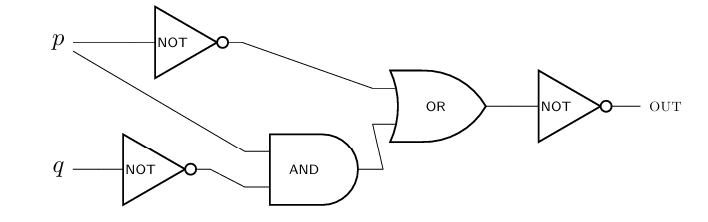
Task 5 – Circuits
Translate the following circuit into a logical expression.